Butter or margarine cutting force measurement

PRINCIPLE OF THE TEST
Evaluation of the cutting force of butter and margarine using a wire cutter.
CONTEXT
The textural properties of butter and margarine, such as hardness, spreadability, granulation, brittleness, smoothness and stickiness, can be determined using the analyzer. CT3 texture. The texture of butter and margarine can vary depending on the temperature, the origin of the milk or oil and the fat content.
Changes in temperature can vary the texture by affecting the consistency of the butter or margarine. They alter the state of fat, thereby varying the distribution of solid and liquid glycerides and the size of fat crystals. In general, larger fat crystals (> 5 µm) and high solids content make the product harder, grainy and more brittle.
The origin of butter or margarine also affects texture by determining the type of fats and predominant fats (saturated or unsaturated) present. A high fat content generally gives a product higher hardness values and low spreadability values. Such products also tend to be more adhesive and less cohesive.
This application compares the cutting force between butter and margarine using the CT3 texture analyzer equipped with a wire cutter on a 4.5 kg load cell. As the wire blade cuts the sample, a measurement of the cutting force or force and the work done (area under the positive curve) can be made. These measurements are an indication of the quality and texture of the sample.
METHOD
Equipment : CT3 with 4.5 kg load cell
Luminaire base table (TA-BT-KIT)
Wire Shear Plate (TA-WSP)
TexturePro CT software
Settings :
Type of test: Compression
Pre-test speed: 1.0 mm / s
Test speed: 0.5 mm / s
Post-test speed: 0.5 mm / s
Target type: Distance
Target value: 35 mm
Trigger force: 30g
SAMPLE PREPARATION
Cut the sample into equal rectangles or squares and return to storage so that the samples can stabilize at the same temperature. The width of the sample should be less than the width of the thread trimmer. Samples should only be removed from storage at the time of testing. Note: For comparison purposes, samples should be of equal length and at the same test temperature.
PROCEDURE
Attach the wire cutter probe to the instrument.
Place the fixture base table on the instrument base and lightly tighten the thumbscrews to allow some degree of mobility.
Insert the wire cutter base plate onto the fixture base table and tighten in position using the side screws.
Align the slot in the thread trimmer base plate with the thread trimmer probe so that the probe can enter through the slot without contacting the plate.
When alignment is complete, tighten the thumbscrews on the fixture base table to prevent further movement.
Remove the sample from the storage location (refrigerator) and place it on the fixture base table.
Lower the instrument arm and align the sample in the center under the wire cutter.
Position the wire cutter a few millimeters from the sample.
Start the test.
Note: When optimizing test parameters, the harder sample should be tested first in order to anticipate the maximum test range required. This will ensure that the force capacity covers the range for other future samples.
RESULTS
The graphics show the cutting force required to slice butter and margarine using a wire cutter.
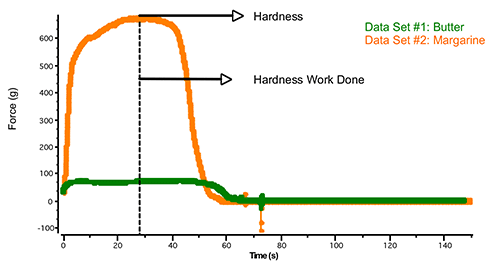
Figure I shows the cutting force of a 5cm x 3cm block of butter and margarine tested at room temperature. The maximum peak on the graph is a measure of the hardness of the sample. The area under the load / time graph from the start of the test to the maximum point is a measure of the hardness work performed.

Figure II shows the force versus distance for the cutting force of a 5 cm x 3 cm block of butter and margarine tested at room temperature.
DISCUSSION
When a trigger force of 30 g has been reached at the surface of the sample, the wire cutter enters the sample for the specified distance of 35 mm. The slope of the graph increases as the wire moves through the sample until a plateau is reached. This is the maximum force required to shear the sample. After the wire blade cuts the sample, the blade continues to move until the specified distance is reached. The probe then returns to its starting position above the sample. The higher the value of the plateau, the firmer the sample and therefore the greater the cutting force. It is clear that butter is firmer than margarine.
The average hardness and hardness work done for the cutting force of butter and margarine are shown below:
| Cutting force | Hardness (g) | Work performed (mJ) |
| Butter | 679.5 | 145.27 |
| Margarine | 73 | 19.46 |