Cashew nut firmness and crunch
PRINCIPLE OF THE TEST
Determination of the firmness and crunchiness of processed and unsheared cashew samples using a homemade knife adapter (TA-CKA) mounted on a CTX texture analyzer.
CONTEXT
Cashew nut, or simply called cashew nut, is widely consumed. Cashews can be eaten on their own, used in recipes, or made into cashew cheese or cashew butter. For this test, cashews were separated into two groups, processed cashew and untreated cashew, each in its original packaging. A CTX texture analyzer with a 10 kg load cell was used with a TA-CKA apparatus to compress the slide and shear in the cashew test samples at a defined distance. The amount of force required to shear the samples is then measured. Cashew samples are placed between the TA-CKA probe and the Fixture Base Table (TA-BT-KIT). When the probe is slowly lowered over the sample, it will break the surface and cut the cashew nut. This will provide data on the firmness and crunchiness of the cashew nut.
METHOD
Equipment : CTX with 10 kg load cell (XCTX)
Luminaire base table (TA-BT-KIT)
Assembly of artisanal knives (TA-CKA)
Texture Pro Software (SWL-02-111)
Settings :
Type of test: Compression
Test speed: 1.0 mm / s
Target type: Distance
Target value: 5 millimeters
Trigger load: 50 grams
SAMPLE PREPARATION
The cashews were separated into two groups, processed and untreated in their original packaging for 48 hours at room temperature, before being tested.
PROCEDURE
- Attach the TA-CKA probe to the CTX texture analyzer.
- Insert two table bolts into the slots in the analyzer base.
- Place the fixture base table on the CTX and lightly tighten the bolt nuts.
- Adjust the table so that the probe is centered on the table.
- When alignment is complete, secure the base table by tightening the bolt nuts. Place the white cutting base on the base table.
- Place the sample on the table. Align the sample under the probe in the center.
- Position the probe approximately 5 mm above the sample.
- Set the test parameters using Texture Pro software.
- Start the test.
Repeat steps 1 through 9 for all test samples.
OBSERVATION
When a trigger load of 50g is detected on the sample surface, the probe compresses and shears the cashews at a test speed of 1mm / s for a specified distance of 5mm. Once the distance of 5 mm is reached, the probe returns to the starting position. The load versus time graph (Fig. 6) indicates typical hardness and fracturing of a cashew sample. The load / distance graph (not shown) shows the work done on the sample to compress and cut it. Cashews were tested five times, and these tests were averaged together. The graphs and table below report the data for these averages.
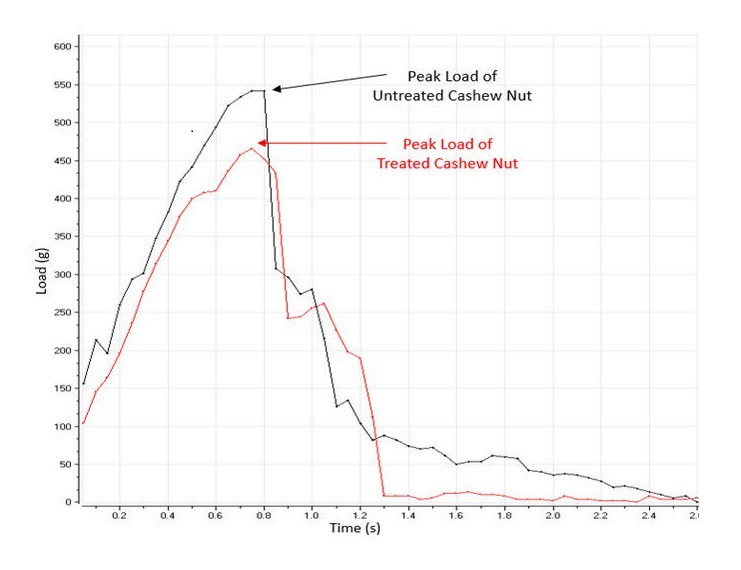
Typical graphic plot between treated and untreated cashew samples.
The axes are Load (g) vs. Dry weather)
DISCUSSION
The maximum force value is the maximum load, which is a measure of the firmness of the sample. The higher the value of the maximum force, the firmer the sample. More work is required to fracture the sample. The hardness indicates the maximum force required to compress a food between the molars, while the hardness work done is the work required to chew the food. Breakage occurs when there is a sharp decrease in load. The amount of fractures provides a strong indication of the crispness of the sample by measuring the number of fractures during the first compression stroke. Only one compression stroke was used in this test. The amount of breaks corresponds to the crunchiness of the cashew nut, indicating its fragility.
DATA REPORT
Texture Pro software is used to program and control the CTX during experimental testing. It automatically measures peak load values and calculates the amount of fractures and other characteristic properties. Untreated cashew is harder, as it required an average force of 548g to shear it. A softer, processed cashew sample only required 460g of force. The table below shows that untreated cashews were harder and required more labor than processed cashews. However, processed cashews have a higher number of fractures than untreated cashews. A lower number of fractures, which results in a crunch in untreated cashews, could be due to a higher moisture content or a lack of drying time in the oven.
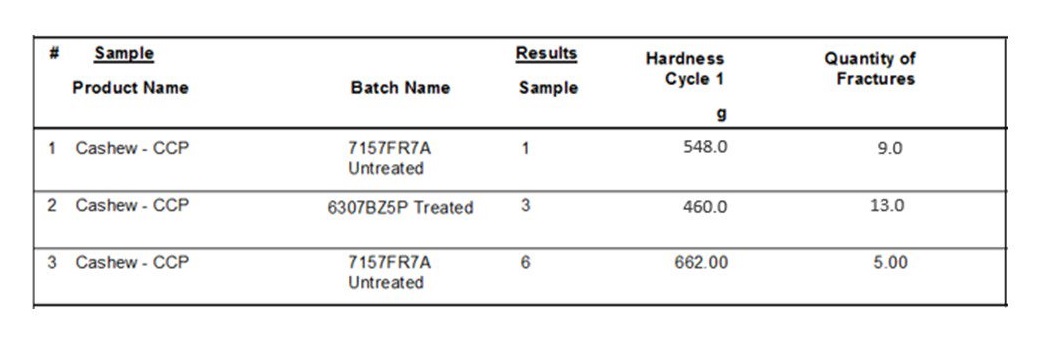
Test the averages of samples of untreated and treated cashew nuts
CONCLUSION
The test results can be used to determine the ideal hardness and crunchiness of cashews. The test procedure, sample preparation, and equipment setup should be followed for reproducible test results.