Case study: Lipstick test according to ASTM D1321-10

PRINCIPLE OF THE TEST
Evaluation of the hardness of lipsticks by penetration with a 2 mm needle probe.
CONTEXT
Waxes and oils are the main components of lipsticks ensuring the firmness of the product and allowing an even distribution of the product during application. The ability of waxes to produce good luster, adequate product firmness, as well as their molding properties, make them complementary to the final product texture. Petroleum waxes, however, differ in their hardness. Measuring the hardness (firmness) of a lipstick by varying the composition and wax content can be a useful tool in quality control to assess whether a wax of interest will be suitable to produce the desired properties. The test can also be used to monitor hardness over a range of temperatures that lipstick may be subjected to during shipping and storage.
The method for testing the hardness of lipstick is adopted from the standard test method ASTM D1321-10. This is a penetration test that measures the hardness of the sample. In the standard method, a penetrometer determines the penetration distance when applying a specified force over a period of 5 seconds. The method described here is an alternative method to the standard and measures the penetrating force at a defined strain distance of 5 mm. The CT3 texture analyzer can also indicate the presence of unwanted air bubbles or a grainy texture, considered to be fluctuations in force values during penetration.
METHOD
Equipment: CT3 with 4.5 kg load cell
Round table base (TA-TR-KIT)
Adjustable locking pliers (TA-AVG)
2mm needle probe (TA39)
TexturePro CT software
Settings:
Type of test: Compression
Pre-test speed: 1.0 mm / s
Test speed: 1.0 mm / s
Post-test speed: 10.0 mm / s
Target value: 5 millimeters
Trigger force: 5 grams
Note: It is recommended that the pre-test speed be the same or slower than the test speed for accurate trigger detection; for example, a test speed of 1 mm / s will require a pre-test speed ≤ 1 mm / s.
PROCEDURE
- Attach the 2mm needle probe to the load cell.
- Make sure the probe is clean.
- Place the round base table at the base of the instrument and lightly tighten the screws to allow some degree of mobility roll the lipstick to its maximum length.
- Slide the adjustable vise handles onto the base table.
- Wrap the lipstick to the maximum length and secure the lipstick base to the vise grips.
- Align the sample in the center under the needle probe.
- Start the penetration test.
- Between tests, carefully wipe the needle towards its tip with a clean, dry cloth to ensure complete removal of all adhering wax.
Note: When optimizing test parameters, it is best to test the hardest sample first in order to predict the maximum test range for subsequent samples.
RESULTS

Figure I shows the force as a function of time for the penetration test on two lipsticks of different formulation tested at 20 ° C.
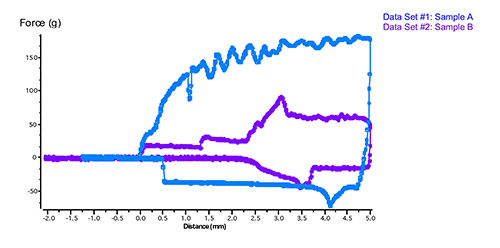
Figure II shows the force versus distance for the penetration test on two lipsticks of different formulation.
OBSERVATIONS
When a trigger force of 5g has been reached, the probe begins to penetrate the sample at a defined distance (in this case 5mm). The maximum force value is then measured as the force required to penetrate the sample at the specified distance. The higher the force value, the harder the sample. Sample A is harder (firmer) than Sample B. The area under the curve is a measure of the work done to achieve the defined penetration distance.
The table below shows the hardness and work performed values for the two lipsticks:
Product | Hardness (g) | Work performed (mJ) |
Sample A | 181 | 6.92 |
Sample B | 91 | 2,111 |