Cheddar Cutting Force Measurement

PRINCIPLE OF THE TEST
Evaluation of the cutting force of melted cheddar cheese using a wire cutter.
CONTEXT
Cheese is made from curd by coagulating the casein in the milk. The type of curd that develops depends on handling techniques, moisture content and aging times. The characteristics of cheese can vary in texture, flavor and consistency depending on the manufacturing process. Therefore, the cheese can be semi-soft, grainy, hard, smooth, crumbly or creamy. Hard cheese, for example, contains less moisture and fat; therefore, drier and firmer than soft cheese. Hard cheese is also aged longer. It is largely the protein matrix that gives rise to the rigid forms of cheese. Changing the nature or amount of protein in the cheese will change its texture. For example, low-fat cheddar cheese (17 % fat) is firmer and more elastic than whole cheddar cheese (35 % fat).
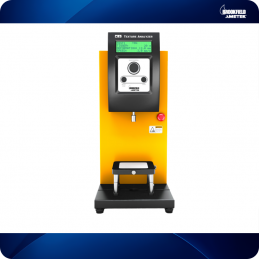
The cutting force of the processed cheddar cheese is studied using the CT3 texture analyzer equipped with a wire cutter on a 4.5 kg load cell. As the wire blade cuts the sample, a measurement of the cutting force (or force) and the work done (area under the positive curve) can be made. These measurements are an indication of the quality and texture of the sample.
METHOD
Equipment : CT3 with 4.5 kg load cell
Luminaire base table (TA-BT-KIT)
Wire Shear Plate (TA-WSP)
TexturePro CT software
Settings :
Type of test: Compression
Pre-test speed: 1.0 mm / s
Test speed: 0.5 mm / s
Post-test speed: 0.5 mm / s
Target type: Distance
Target value: 30 mm
Trigger force: 50 grams
SAMPLE PREPARATION
Cut the sample into rectangles or equal squares and return to storage (refrigerator). The width of the sample should be less than or equal to the width of the thread trimmer. Samples should only be removed from storage when they are ready to be tested.
PROCEDURE
- Secure the wire cutter to the instrument.
- Place the fixture base table on the instrument base and lightly tighten the thumbscrews to allow some degree of mobility.
- Insert the wire cutter base plate onto the fixture base table and tighten in position using the side screws.
- Align the slot in the base plate with the thread cutter so that the thread trimmer probe can penetrate through the gap in the base plate without contacting the plate.
- When alignment is complete, tighten the thumbscrews on the fixture base table to prevent further movement.
- Remove the sample from the storage location (refrigerator) and place it on the luminaire base plate.
- Lower the probe and align the sample in the center under the wire cutter
- Position the wire cutter a few millimeters above the sample.
- Start the test.
Note: Always make sure that the test begins when the wire cutter is fully in contact with the sample surface. The test should not start with the wire cutter having sheared the sample to some extent. If there is an irregularity with the sample surface, a higher trigger force may be required. For comparison purposes, samples should be of similar size and temperature. The harder sample is best tested first in order to anticipate the maximum testing range required. This will ensure that the force capacity covers the range of other samples tested.
RESULTS
The graphics show the cutting force of processed cheddar cheese using a wire cutter.

Figure I shows the force required to cut a 90mm x 30mm cm block of cheddar cheese stored at 6 ° C and tested at room temperature. The maximum load value on the graph is a measure of the hardness of the sample. The area under the graph from the start of the test to the maximum force value is a measure of the work done. Negative load values result from the wire cutter reversing its path through the sheared sample.

Figure II shows force versus distance for cutting force of a 90mm x 30mm block of cheddar cheese. The maximum load is a measure of the hardness of the sample, and the area under the load / distance curve between the start of the test and the target distance (30 mm) is a measure of the sample work performed. Negative load values result from the wire cutter reversing its path through the sheared sample. The zero-load horizontal line is produced when the probe detaches from the sample and returns to its starting position on the sample surface.
OBSERVATIONS
When a trigger force of 50 g was reached at the surface of the sample, the wire cutter proceeded to penetrate the sample a specified distance of 30 mm. It was seen that the penetrating force increased rapidly at the start of the test before reaching a plateau. This is a measure of the force required to cut through the sample and is an indication of the sample's hardness (firmness). The higher the maximum force value, the firmer the sample.
The average hardness and work performed values for three samples of processed cheddar cheese are shown below:
| Hardness (g) | Hardness Work performed (mJ) |
| 491.3 ± 1.8 | 109.63 ± 1.45 |