Measuring the elasticity of noodles

PRINCIPLE OF THE TEST
Assessment of elasticity of noodles using a noodle pulling device.
CONTEXT
The noodle traction device consists of lower and upper friction rollers which are knurled to ensure a firm grip. The rollers have a slot (orifice) through which the sample can be passed before wrapping the sample around each friction roll. The sample is wound two to three times on each roll to anchor the ends of the sample. Samples can also be wound directly onto the friction rollers without using the orifice. The choice of the method used must be consistent for each test performed. Before starting a test, the sample should be fully extended without any weak points along its length. A test is considered successful if the sample breaks along the extended portion.
METHOD
Equipment:
Instruments: CTX with 50Kg load cell
Accessory: TA-BT-KIT TA-NTF Noodle Tensile Fixture Base Table
Software: Texture Pro software
Settings :
Type of test: Voltage
Pre-test speed: 1.0 mm / s
Test speed: 3.0 mm / s
Post-test speed: 3.0 mm / s
Target type: Distance
Target value: 40.0 mm
Trigger force: 5 grams
Note: Thicker samples may require higher trigger load and longer voltage distance
SAMPLE PREPARATION
When preparing the sample, the noodles should be cooked under controlled conditions. The weight of the dry noodles, the volume of water used, the cooking time, the draining time, and the time between cooking and testing should be kept constant for comparison. For this application, 100 g of noodles were placed in a microwave-safe dish containing 300 ml of boiling water. The noodles were cooked for 5 minutes in a 900W microwave. Samples were allowed to cool for 1 minute before testing.
In general, cooking times and the volume of water used will vary depending on the size and weight of the sample.
PROCEDURE
Place the lower friction roller on the base of the instrument and lightly tighten the T-bolts to allow some degree of mobility.
Attach the top roller to the probe shaft of the instrument.
Lower the instrument arm until the upper friction roller is within a few millimeters of the lower friction roller.
Align the lower friction roller with the upper friction roller by repositioning the lower roller.
When alignment is complete, lock the T-bolts on the lower roller to prevent further movement.
Lift the instrument arm to provide enough space to wrap the sample.
Pass the sample through the hole in the upper friction roller, then wrap the sample 2-3 times on the roller. Tighten the screw on the upper friction roller to prevent further movement before repeating this procedure for the lower friction roller. Samples can also be wound onto the rollers without passing through the orifice.
Lift the instrument arm to extend the sample.
Note: Always make sure that there are no apparent weaknesses along the entire length of the sample before performing a test as this can reduce tensile forces and distance to breaking point values .
When testing different brands of noodles, it is best to test the hardest sample first in order to anticipate the maximum testing range required. This will ensure that the force capacity covers the range for the other samples tested.
RESULTS
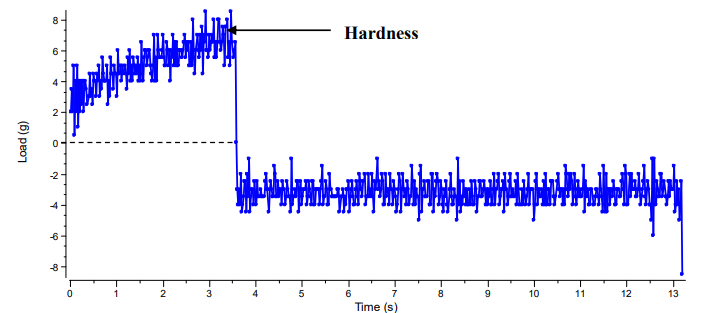
Graph of Figure IA to show the extensibility of the noodles using a noodle pulling device
The maximum peak force is a measure of the hardness of the sample. This is the force required to break the sample.

Figure II A graph of load versus distance for noodle stretch using a noodle traction device
This is an alternate option to view the results. The graph shows similar characteristics to the load / time graph but with an additional measurement. The load / distance graph can measure the distance to the point of failure. This value can be used to compare the elasticity of samples. The longer the distance to the point of failure, the greater the elastic component of the sample.
Note: If only noodles are tested and there is no requirement for any other type of pasta, a 1000g or even 100g CT3 instrument can be used for this test.
OBSERVATIONS
When a trigger load of 5 g has been reached, the upper pull clamp will stretch the noodle a distance of 40 mm at a test speed of 3 mm / s. When the elastic limit of the noodle has been exceeded, the noodle cracks. This is observed as the maximum tensile force on the graph (see fig. 1 and 2), the higher the value of the force; the higher the tensile strength of the sample. The elastic component of the sample can also be tested. From the load versus distance graph, the measured distance to the point of failure is an indicator of the elasticity of the sample; the greater the extension distance, the more elastic the sample.
The table below summarizes the average results of two samples:
| | Peak load (g) | Deformation at maximum load (mm) |
| Noodles | 8 ± 0.7 | 9.84 ± 0.97 |