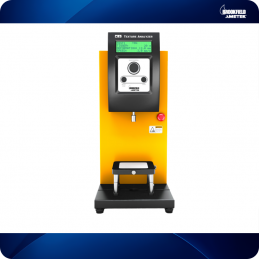
Case study: Toothpaste consistency measurement

PRINCIPLE OF THE TEST
Evaluation of the consistencies of the content of two toothpastes using a tube / sachet extrusion tool.
CONTEXT
Manufacturers in the rapidly changing consumer product space package many of their products in pouches and tubes for quick and easy access. In cosmetics and personal care industries, tubes and sachets are widely used, ranging from makeup and hair care products to hand cream, facial cleansers and many more. Sachets and tubes are a consumer-friendly way to promote and retail liquids, creams and gels.
In the health and nutrition industry, pouches can be used as single-use packaging for sports drinks and gels, a convenient solution for people on the go. The sachets can also be used as unit doses without a spoon.
In the food industry, many condiments such as ready-made sauces, pastes and dressings, among other products, can be packaged in sachets or tubes for quick and easy use. Pouches and tubes are also widely used in industrial products, such as lubricants for bearings and clutches, and household cleaning products, such as adhesives and polishes, among others.
The general use of pouches and tubes is to provide quick and easy extrusion of contents and application. The consistency of the product, defined by the viscosity or thickness of the contents, will dictate the force required to extrude the contents of the package. The tube / bag extrusion device is designed to measure the force required to extrude the contents of a tube or bag. The higher the force value, the more viscous the sample and the more difficult it will be for a consumer to extract the contents.
METHOD
Equipment : CT3 with 4.5 kg load cell
Luminaire base table (TA-BT-KIT)
Double extrusion cell (TA-DEC)
TexturePro CTParameters:
Type of test: Voltage
Pre-test speed: 1.0 mm / s
Test speed: 2.0 mm / s
Post-test speed: 2.0 mm / s
Target type: Distance
Target value: 30 mm
Trigger force: 20 grams
PROCEDURE
Attach the traction device to the load cell.
Secure the base table to the base of the instrument and lightly tighten the screws to allow some degree of mobility.
Place the sample holder loosely on the base table.
Insert the sample with its hole facing down between the support rollers and fix it at the chosen tension.
Lower the upper traction device and align it with the upper traction device and tighten the screws.
After alignment, tighten the base table screws.
Place a drip tray under the sample.
Remove the cap or open the pouch.
Start the test.
RESULTS
Typical layout: A comparison of the consistencies of two toothpastes.

Number I
Figure I shows the force required to extrude the contents of toothpaste tubes of different formulations into 100ml tubes.
Data Set # 1: Premium Toothpaste
Data Set # 2: Economical Toothpaste

Figure II shows the load versus distance for extruding formulations (premium and budget toothpaste) into 100ml tubes.
Data Set # 1: Premium Toothpaste
Data Set # 2: Economical Toothpaste
OBSERVATIONS
When a release force of 20g has been reached, the extruder exerts a tensile force on the tube by pulling the tube through the support rollers a specified distance of 30mm. The maximum force (maximum load) required to extrude the content the specified distance is a measure of the force required to extrude the sample. The higher the force value, the more viscous the sample. The test can also give us insight into the pseudo-plastic / dilating properties of the samples. A sample with a high pseudoplastic property will exhibit decreasing viscosity with increasing shear rate and an expander will exhibit increasing viscosity with increasing shear rate. The hardness work done tells us about the energy required for the extrusion of the samples; the higher the values, the more energy the consumer will need to extract the contents of the tube or sachet. According to Figure 1, the economical toothpaste requires more force to extrude its contents, making it the more viscous of the two.
The average maximum load and strain at maximum load values for the two toothpastes are shown below:
| Peak load (g) | Work performed (mJ) |
| Premium toothpaste | 1625 | 344.9 |
| Budget toothpaste | 2995 | 712.8 |