Case Study: Texture Measurement of Eye Pencils
PRINCIPLE OF THE TEST
Evaluate the hardness of the pencil tips for the eyes.
CONTEXT
The hardness of a pencil tip for the eyes is important; the texture of the eyeliner should be such that upon application it glides on smoothly without effort, allowing ultimate control and flexibility. The consistency of the eyeliner as well as its soft texture will therefore influence its performance. For example, a tip that is fairly dry may cause discomfort to the user during application by pulling or pulling on the delicate eye tissue.
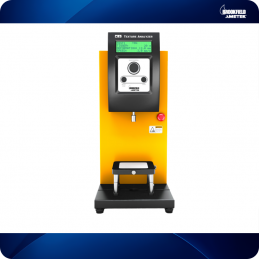
The CT3 or CTX Texture Analyzer uses an eye pencil platform to quantitatively measure the hardness of eye pencils and lip liner tips.
METHOD
Equipment: CT3
Eye pencil stencil (TA-EP)
TexturePro CT software
Settings:
Type of test: Compression
Pre-test speed: 0.5 mm / s
Test speed: 1.0 mm / s
Post-test speed: 4.5 mm / s
Target value: 8 mm
Trigger force: 5 grams
Note: The penetration distance can be changed, however, the target distance chosen must be such that the probe does not touch the base of the device's base table, otherwise the instrument will be overloaded. The hardness values will also increase with increased penetration depths. Therefore, for comparison purposes, penetration distances should always be reported.
PROCEDURE
1.Attach the eye pencil template to the load cell.
2.Place the sample in the diagonal hole of the template.
3.Position the base table in the center under the tip of the pencil, then tighten the base table screws.
4.Lower the pencil jig approximately 1cm above the base table.
5. Secure the sample in the hole in the desired position by tightening the screw on the jig so that the tip of the pencil is at an angle to the base table.
6.Start the compression test.
Note: When optimizing the test parameters, the harder sample is tested first in order to predict the maximum test range for subsequent samples.
RESULTS
A graphic to show the compression of an eye pencil.

OBSERVATIONS
When a trigger force of 5g is detected, the test begins. The probe deforms the sample up to a deformation distance of 8 mm. The maximum peak in Figure 1 represents the force required to cause the sample to initially break.
The tests obtained from 4 eye pencils from the same batch give the following average values of Hardness and Hardness Work performed below:
Hardness (g) Deformation of the
hardness (mm) Hardness Work performed (mJ)
3723.8 ± 19.6 7.99 ± 0.01 86.09 ± 7.5