Firmness measurement of sliced bread

NOTE: Adaptation of the AACC 74-10A compression test to assess the freshness of sliced white bread.
OBJECTIVE OF THE TEST
Measure of the firmness of bread as an indication of freshness versus stale.
PRINCIPLE OF THE TEST
A single 25 mm slice or two 12.5 mm thick slices are placed under a cylindrical probe 38.1 mm in diameter. The bread is compressed to 3 mm and the peak load is used as an indication of freshness. In addition, the sample can be compressed at a certain load. The distance traveled to achieve this load is compressibility, which is an indication of softness.
CONTEXT
The original AACC method for bread compressibility specifies an apparatus known as the Baker Compressimeter, which quantifies the compressibility of a bread sample. The test is based on the theory that the maximum load increases and the compressibility decreases as the bread ages.
This suitable method of compressing bread not only provides valuable information regarding product stale, but can also provide invaluable indication of differences in texture resulting from ingredient handling and formulation.
METHOD
The test sample is placed on the table with the center side of the bread facing up. Center the sample under the probe. During the test, the compressive load detected by a cylindrical plexiglass probe (TA-4) 38.1 mm in diameter is continuously recorded via software.
Settings :
Fashion: Compression
Pilot: Culminate
Test speed: 1.0 mm / s
Distance: 3 m / m
Option: Normal
Trigger: 4 g automatic trigger
MEASURES
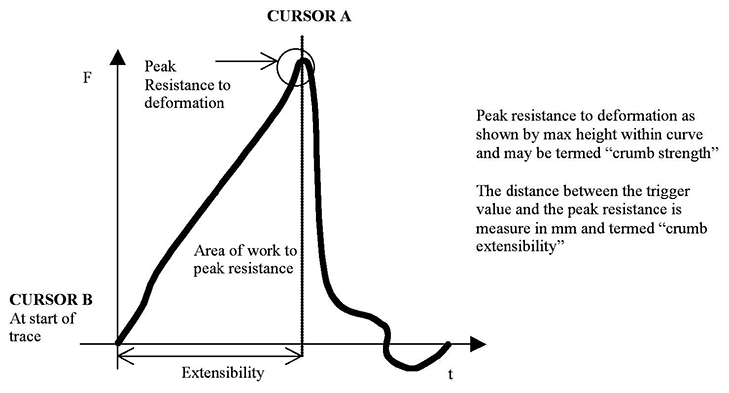
SETTINGS
Crumb resistance: Maximum resistance to deformation
Crumb Stretch: Distance from trigger point to peak resistance
Crumb Work: Zone between trigger point and maximum resistance
RESULTS Day 1
Crumb strength: 483 grams
Scalability of crumbs: 21.2 mm
Work of crumbs: 4273.7 g
EMPIRICAL FACTORS
Test conditions that will affect the generated results:
1.Sample size
2.Age of sample
3.Sample container and / or test probe used
4.Positioning and centralization of the sample
Sample conditions that will affect the generated results:
1.Formulation and composition
2.Cook or process treatments
3.Storage and display of samples
RELATED TESTS
TPA type evaluation of the bread sample
Adaptation of the AACC method (74-09) for the firmness of bread
Stress relaxation as an indicator of bread stale
DISCUSSION
Observations of the trace give a good indication of the quality of the bread. Results over a stale period showed the largest and most significant difference between samples in crumb extensibility and work area up to maximum strain. The maximum values for the strength of the crumbs have been shown to illustrate some inconsistency, which may affect the significance of the test data obtained. The test procedure determined the elasticity and fracture characteristics of the tested samples and generated a crumb strength indication representative of the consistency of the product.
Further work with bars of known formulation is recommended under controlled conditions to illustrate the potential for application of such tests in a quality or production environment.
CONCLUSION
This method is very simple to follow and provides valuable data related to both the stale properties and the composition of the bread. The method can therefore be integrated into both quality and development programs as a means of optimizing product quality. In addition, the correlation of the data generated with the perceived sensory characteristics further extends the value of these tests.