Case study: Measuring the spread of petroleum jelly

PRINCIPLE OF THE TEST
Evaluation of the spread of petroleum jelly at 4 ° C and 21 ° C using male and female conical probes.
CONTEXT
Spreadability is the ease with which a sample spreads over a surface in a thin, uniform layer. The measure of firmness (by penetration) and spreadability are strongly correlated. Therefore, the spread values of a sample rich in lipids will decrease with increasing oil viscosity (increase in hardness), resulting in an increase in surface tension, giving a greasy and sallow feeling. adhesiveness when applied to the skin.
Vaseline is used as an ingredient in skin lotions and cosmetics. It is a semi-solid mixture of hydrocarbons. It falls under the category of moisturizers as an occlusive, trapping water in the skin preventing it from evaporating.
The spreadability of petroleum jelly is an important property measured using a spreader consisting of a set of paired male and female Perspex cones, a cone sample holder and d 'basic support. The test measures the force required to achieve a given strain and correlates these values with sensory estimates of spreadability. As the male probe enters the female probe, the sample is compressed and extruded from the female probe at an angle. This process simulates spreading the sample over a surface.
METHOD
Equipment : CT3 with 4.5 kg load cell
Luminaire base table (TA-BT-KIT)
Spreading device (TA-SF)
TexturePro CT software
Settings :
Type of test: Compression
Pre-test speed: 1.0 mm / s
Test speed: 3.0 mm / s
Post-test speed: 3.0 mm / s
Target type: Distance
Target value: 13 mm
Trigger force: 5 grams
Additional materials:
Spatula
Tissue roll
Flat knife
SAMPLE PREPARATION
Fill the four lower cones (female cones) with the sample using a spatula (the fifth cone is left empty as it will be used for alignment, see test procedure). Care should be taken not to overwork or whip the sample.
Press the sample down to remove any air pockets visible through the Perspex cones.
Level the surface with a flat knife and let sit at the specified temperature for a few hours.
PROCEDURE
Position the base table on the base of the machine.
Tighten the base table screws, while allowing some degree of mobility.
Install the base stand on the base table and lock it in position with the screws.
Insert an empty female cone into the sample holder of the female cone.
Attach the male cone to the load cell.
Precisely align the male and female cones by lowering the male cone and repositioning the female cone so that the male probe moves into the female cone, until they are almost in contact.
The base table screws can now be tightened.
Remove the empty female cone from the sample holder and replace it with a prepared sample (see sample preparations section).
Position the male probe a few millimeters above the sample. This distance should be applied for all subsequent tests so that the starting point is the same, allowing comparisons between samples.
Start the test.
Notes: Accurate alignment of the probes is essential to avoid overloading the instrument. Penetration depths should not exceed 90 % the height of the probe.
Fluctuations on a smooth curve are the result of compressing air pockets. It is therefore important to minimize air pockets when filling the female cone.
The base holder should not be removed from the base table between tests as this will require realignment of the male and female probes. The female cone can be removed after the test by loosening the screws on the base support.
For comparison purposes, the test temperature should always be reported in the results.
RESULTS
The following graph shows a typical TexturePro CT plot of the spreadability of petroleum jelly.

Figure I shows the spreadability of petroleum jelly tested at 4 ° C using 21 ° C.
Data set # 1: Petroleum jelly at 21 ° C
Data set # 2: Petroleum jelly at 4 ° C
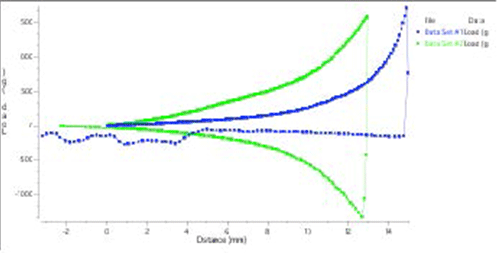
Figure II shows the load as a function of distance for the spreadability of petroleum jelly tested at 4 ° C and 21 ° C.
Data set # 1: Petroleum jelly at 21 ° C
Data set # 2: Petroleum jelly at 4 ° C
OBSERVATIONS
When a trigger force of 5 g has been reached at the surface of the sample, the male cone enters the sample during a test. speed of 3 mm / s during which the penetration force is seen to increase to a maximum at a specified depth (13 mm in this test). The maximum force at a penetration depth of 13 mm gives an indication of the firmness of the sample. The higher the force value, the firmer the sample. The area under the positive peak is a measure of the hardness work performed. Any air pockets in the sample will be indicated by the fluctuations in the penetrating force on the graph.
When the male probe withdraws from the sample at the post-test rate of 3 mm / s, a negative peak is generated. The negative peak is a measure of the bond strength; the more negative the value, the more “sticky” the sample. The area below the negative portion of the graph is known as tack (the energy required to break the sample contact with the probe). The higher the value, the more energy it takes to break the contact of the probe with the sample when the probe withdraws from the sample.
The results of four petroleum jelly samples stored at 21 ° C or 4 ° C give the following average hardness and work performed values:
| Test temperature (° C) | Hardness (g) | Hardness Work performed (mJ) |
| 4 | 1854.5 ± 70.9 | 67.13 ± 12.35 |
| 21 | 1001.3 ± 93.7 | 27.04 ± 9.53 |