Rheological properties of powders used for the production of pharmaceutical tablets

PRINCIPLE OF THE TEST
Characterize and test the bulk density of powders to ensure accurate tablet manufacturing. By setting the correct pressure to use in a tableting operation, this pressure can then be measured by an accurate bulk density test.
CONTEXT
A Brookfield Powder Flow Tester, equipped with Powder Flow Pro software for automated instrument control and data acquisition, is used to test powders for accurate bulk density measurements to ensure the correct pressures are used in a tablet manufacturing process. By quickly and accurately measuring bulk density at different consolidation stresses, it becomes possible to maintain or adjust the pressure of the manufacturing die and ensure a smooth production run.
METHOD
Equipment
Instrument: Powder flow tester
Hollow: 230 cc, 6 inches in diameter
Type of cover: Wall cover, 304 s / s, 2B countersunk finish, 6 inch diameter
Type of test: Autonomous bulk density
MEASURED PARAMETERS
Infill and final bulk density
PROCEDURE
The trough was weighed and the balance then tared. The powder consisting of an API and a multitude of excipients was taken from the trough; the scraping tool was used to evenly distribute a flat annular ring of powder in the trough. The wall mounted friction cover is used in this stand-alone bulk density test. The trough with the powder sample was then weighed and the weight recorded in the Powder Flow Pro software. A stand-alone bulk density test was selected and performed. The duration of the test is approximately 1 minute and 40 seconds.
RESULTS
This graph displays the infill and final bulk density of the material, from the initial loose infill condition to five increasing values as the consolidating stress increases.
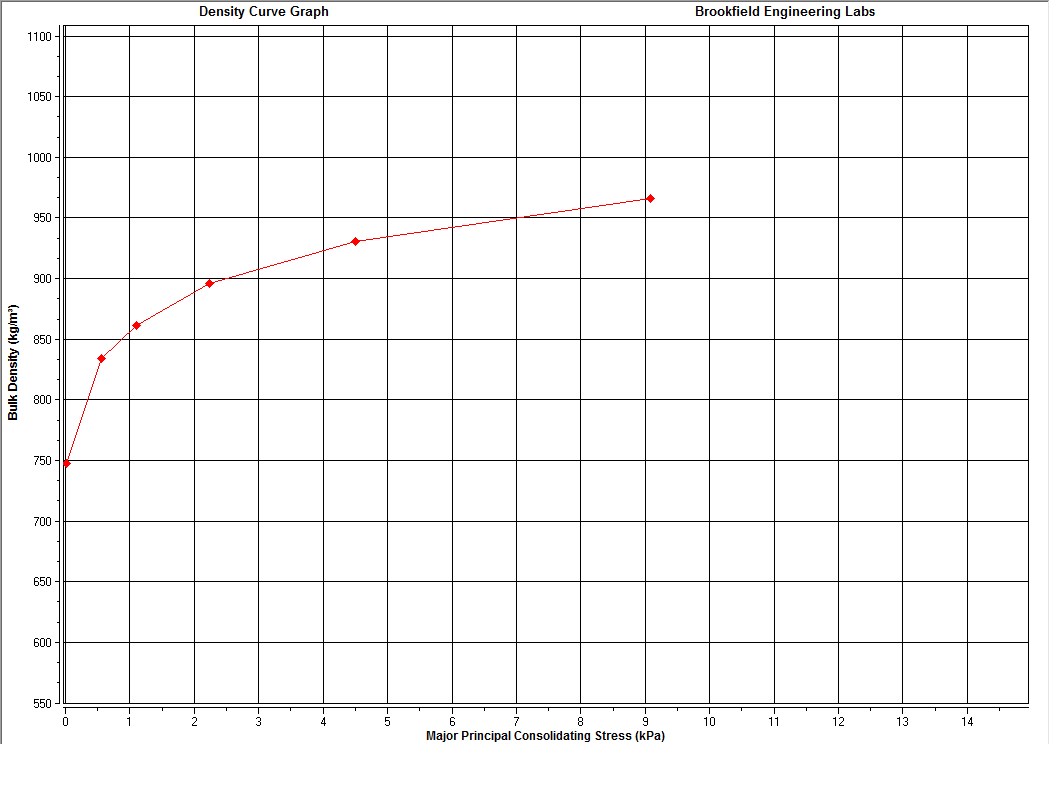
Figure 1: Bulk density graph
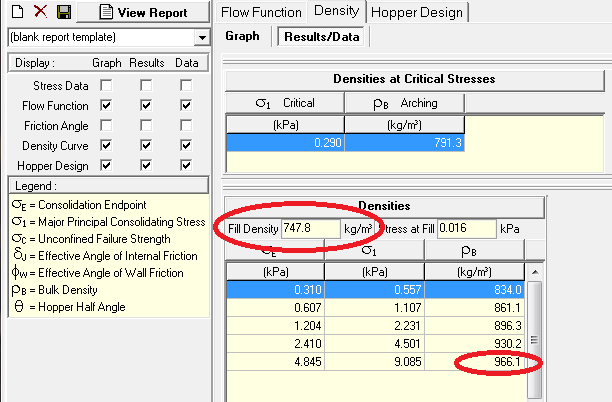
Figure 2: Bulk density values
DISCUSSION
A known final bulk density value is set to apply the correct amount or pressure to a tabletting die. By monitoring this value with a bulk density test, the pressure in the die can be increased or decreased accordingly to ensure that the tablets will be produced uniformly. By qualifying the material in advance, the correct amount of pressure can be applied to achieve the desired bulk density of the material.
In addition, the cohesion of the material can be measured for flow in the dye by evaluating the difference between the infill and the final bulk density values. If this change is from 30 to 50 %, this indicates a more cohesive material and more difficult to flow. For example, in the bulk density values graph of Figure 2, the initial infill density value is 747 kg / m3 and the final bulk density value is 966 kg / m3. By subtracting the initial bulk density value from the final bulk bulk density value and dividing by the bulk bulk density value, a difference of 29 % is determined, indicating that this material will be somewhat difficult to dispose of.