


Is Bubble Tower Temperature Calibration in Corrosion Testing Really Necessary ?
Is Bubble Tower Temperature Calibration in Corrosion Testing Really Necessary ?

 AMETEK BROOKFIELD
 ASCOTT ANALYTICAL EQUIPMENT LTD
 ATP ENGINEERING BV
 BINDER GmbH
 BUCKLEYS (UVRAL) LTD
 COATMASTER
 DAKOTA ULTRASONICS
 DEFELSKO CORPORATION
 FORMAT MESSTECHNIK GmbH
 HACH LANGE
 HANGON
 HANNA INSTRUMENTS FRANCE
 HILDEBRAND
 KERN & SOHN GmbH
 LABOMAT ESSOR
 LAUDA
LAUDA
 LENETA COMPANY
 MITUTOYO FRANCE
 Q-LAB CORPORATION
 RHOPOINT INSTRUMENTS
 RK PRINT COAT INSTRUMENTS Ltd
 SIGMUND LINDNER GmbH
 TABER INDUSTRIES
 TAYLOR HOBSON LIMITED
 TESTO
TESTO
 TQC BV
 VEOLIA WATER STI
 VERIVIDE
 WALLACE
 X-RITE EUROPE GMBH


For linoleum and other types of resistant floor coverings.
Heavy-duty flooring adhesives generally produce widely varying viscosity test results when using standard viscometers. The RST-SST rheometer in a performance test with modulus calculation (slope of the line leading to the yield strength) quickly qualifies the product with consistently reproducible results, thus providing an improved quality control procedure.
Instrument: RST-SST Soft solids tester
Geometry: VT-20-10
Pallet spindle software: RHEO 3000
Shear Rate Control (CSR) with the paddle spindle rotating at low speed.
• A step
• Start RPM = 0.5
• End RPM = 0.5
• Time = 30 seconds
• Plot = stress on the Y axis, strain on the X axis
• Regression analysis using values up to 40 % maximum shear stress
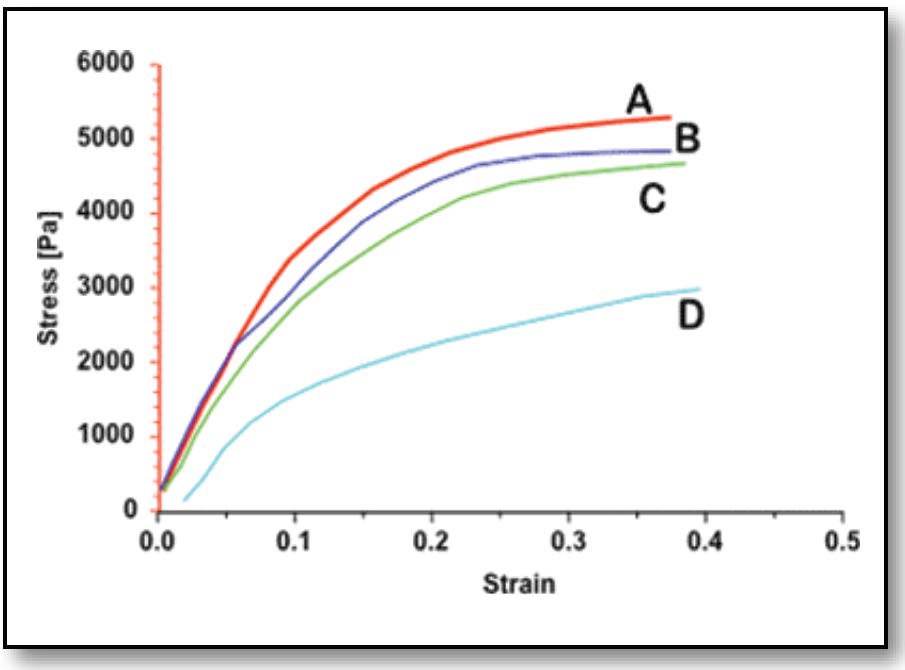
Four types of adhesives are evaluated in Figure 1. The modulus determination has been defined to evaluate up to 40% of the maximum stress value. The following modulus values have been reported:
Sample A: G = 35550 Pa
Sample B: G = 34419 Pa
Sample C: G = 28862 Pa
Sample D: G = 16652 Pa
The pallet axis geometry easily accommodates adhesives of varying consistency and produces a repeatable curve that allows for rapid pass / fail testing. In FIG. 1, sample D has the lowest modulus and therefore spreads the most easily. Samples A and B have the highest modulus and are comparatively stiffer on plating.
Is Bubble Tower Temperature Calibration in Corrosion Testing Really Necessary ?
What difference in gloss units is visible to the human eye?
Case study: Measurement of the consistency of crème fraîche
Reference: Dureté Shore / DIDC / Micro DIDC
What are the differences between Shore, DIDC, Micro DIDC hardness scales?
Labomat Essor and its partner Q-Lab are pleased to offer you a free copy of ASTM D7869: Standard Practice for Xenon Arc Exposure Test with Enhanced Light and Water Exposure for Transportation Coatings.
Case study: Measuring the texture of cheese sticks
Should I Be Concerned with Color Change or with Polymer Degradation ?
Case study: Measurement of candy hardness and crunchiness
Why is an air preconditioner used with the Q-FOG CRH Cyclic Corrosion Tester ?


