Measurement of soluble salts in accordance with ISO 8502-6 and ISO 8502-9 standards - the Bresle method
DeFelsko's PosiTector SST Soluble Salt Tester is the simple, durable and accurate way to measure salt contamination tests according to ISO 8502-6 - the Bresle method.
ISO 8502-6: 2006 Preparation of steel substrates before application of paints and related products - Tests to assess the cleanliness of a surface - Part 6: Extraction of soluble contaminants for analysis - Bresle method
ISO 8502-9: 1998 Preparation of steel substrates before application of paints and related products - Tests to assess the cleanliness of a surface - Part 9: In situ method for the determination of water-soluble salts by conductimetry
This article provides an overview of the Bresle method for measuring salt contamination, a comparison of the three different patch options offered by DeFelsko and explains how the test is performed.
Context

Prior to the application of protective coatings, steel substrates should be carefully prepared and cleaned to ensure that the coating will meet performance requirements and prevent premature failure. As part of this surface preparation, abrasive blast cleaning is commonly used to remove oxidation and existing coatings from the steel. Once the bare steel surface is exposed, there is an ever-present risk of contamination from water-soluble salts that occur naturally in an environment. Soluble salts are not visible to the naked eye. If they are allowed to remain on the substrate in sufficient amounts, they can suck moisture through the coating, causing premature failure of the coating by blistering or osmotic detachment. In some cases, the abrasive blasting medium itself can become contaminated with a water soluble material (for example, chloride or sulfate salts) which is then transferred to the steel surface during cleaning and can ultimately cause premature coating failures.
The Bresle method
To prevent the premature occurrence of coating defects due to salt contamination, it is essential to ensure that the amount of soluble salts present on the spray cleaned surface does not exceed acceptable levels. The water soluble salt test is carried out in accordance with ISO 8502-9. In this method, the extraction of soluble saline contaminants for analysis is carried out in accordance with ISO 8502-6 - Bresle's method.
Bresle's method samples a surface by "surface extraction". Simply put, this method involves placing a volume of water in a chamber against the surface. Water dissolves soluble salts present on the surface, increasing the electrical conductivity of water. The measured increase in conductivity establishes the concentration of soluble salts. Note that there is no "industry standard" for acceptable levels of surface contamination. As such, the project specifications must indicate the maximum amount of soluble salts that can remain on the surface during the application of the coating.
DeFelsko's measurement solution
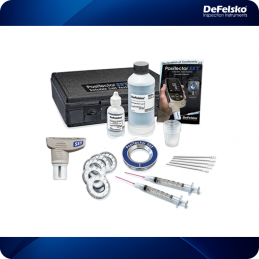
The PosiTector SST conductivity measuring probe, when used in conjunction with either the Bresle PosiPatch or Bresle DeFelsko Patch Method, greatly simplifies the process of measuring soluble salt contamination. It represents a simpler and easier way to use the Bresle method. Like all DeFelsko products, each kit contains everything you need to start measuring. The PosiTector SST is factory calibrated and includes a detailed calibration certificate traceable to NIST.
When connected to a PosiTector Standard or Advanced box, the PosiTector SST conductivity probe guides users through the three simple steps required to take a conductivity measurement. It has a specially designed measuring cell optimized for the range, resolution and test volume of the Bresle method. A built-in temperature sensor compensates the reading for accuracy and records the sample temperature during each measurement.

The change in conductivity and surface density of salts is automatically calculated, displayed and stored in memory for further reporting with DeFelsko's PosiSoft suite of software solutions. There's no need for math, unit conversions, or adjustments for volume and temperature. The duration of the test is automatically measured and recorded.
When 'Bresle mode' is disabled, the PosiTector SST becomes a standard conductivity meter, making it ideal for testing abrasive materials in accordance with ISO 11127-6 and ASTM D4940-15.
DeFelsko offers a wide variety of PosiTector SST Soluble Salt Tester Kit options:
DeFelsko offers three patch options which are ideal for testing according to the Bresle method.
- DeFelsko PosiPatch - Reusable patch with standard or flexible magnetic ring
- DeFelsko adhesive patch - Self-adhesive polyurethane patch
- Latex Adhesive Patch - Latex patch with easy-to-open tabs and low tack adhesive for easy removal trois Image showing three Bresle method patch options.
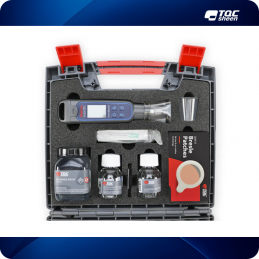
Labomat Essor also offers the TQC patch
Although the PosiTector SST probe can be used with any patch that meets the requirements of the Bresle method, the revolutionary PosiPatch patch has many advantages:
The revolutionary PosiPatch patch further simplifies the Bresle method. It is functionally equivalent to the Bresle patch, but requires no adhesive, as it is held against the surface by a rigid or flexible magnetic retaining ring.
It has a built-in port that allows fluid to be injected using a dull polypropylene dispensing tip, eliminating sharp needles from the test. It features a patented breathable membrane, which automatically releases trapped air when injecting water, and then agitates the water as it is removed.
It is also reusable and a single PosiPatch can be used for multiple tests, making it the cheapest patch option available.
In our testing on freshly blasted steel with a typical profile of 50-100 microns (2-4 mil), the PosiPatches have been reused dozens of times without noticeable wear or leakage.
The lifespan of the patches varies according to the use: if they slide along the substrate, the lifespan will be reduced. We believe 10 uses is a very conservative estimate of lifespan and still gives the lowest cost per test of any commercially available Bresle patch. Some of our customers have told us that they have used the patches more than 50 times!

How to carry out the measurements with the PosiTector SST?
Step 1:
Pour at least 4 ml of deionized (demineralized or reverse osmosis) water into a clean beaker to avoid contamination of the water source. Fill the syringe with deionized water from the cup. The PosiTector SST automatically displays the previous background measurement. Press the minus button on the PosiTector to use the previous measurement. To take a new background measurement, fill the test cell with water from the syringe and press the plus button to save the new measurement. Return the water to the syringe, removing all the solution from the test cell. Invert the syringe and squeeze the air and excess solution out until there is three ml of solution left in the syringe.
2nd step:
If you are using the PosiPatch, place it in the magnetic ring first, being careful not to touch the inside. Place the magnetic ring on the surface and inject the water into the patch using the port. The air inside the patch automatically escapes through the breathable membrane. If you are using DeFelsko Adhesive Patch or Latex Adhesive Patch, remove backing and foam core from the patch, being careful not to touch the inside. Press down firmly on the surface making sure that most of the air escapes. Pierce the top of the patch around the foam perimeter, allowing the needle to penetrate the center of the patch. Inject about half of the water into the patch. Then remove the air from the patch. Remove the syringe from the patch and expel the air. Inject the rest of the water into the patch. Once water is injected into one of the patches, press the plus button on the PosiTector SST to start the test timer. Use the syringe to inject and withdraw the water several times. ISO 8502-6 recommends that this process be performed at least four times and that the test time be agreed between the interested parties. Often two minutes is enough.
Step 3:
After the desired time has elapsed, use the syringe to remove the water from the test patch. To complete the measurement, inject the water into the PosiTector SST test cell and press the plus button. The initial background reading is automatically subtracted from the final reading, and the test results are displayed in units of µS / cm (conductivity) and mg / m2 or µg / cm2 (surface density) along with test time and temperatures sample - information required by most standards.
Press the plus button again to start a new test. If memory is enabled, all results are stored for later upload to one of DeFelsko's PosiSoft solutions, making it easy to organize measurement data and create fully customizable professional reports. Once a reading is stored in the PosiTector memory, four free PosiSoft solutions can manage the data and create reports. The patch can now be removed from the surface. DeFelsko adhesive and latex patch peels off the surface more easily and with less residue than conventional Bresle patches. He is eliminated after the test. The PosiPatch lifts cleanly from the surface, without any residue. Simply use the syringe to rinse it with DI water and reuse it several times until it is worn or dirty.

conclusion
The PosiTector SST Soluble Salt Tester makes the process of measuring and reporting salt contamination faster, easier and more accurate. The adhesive patches and the innovative, reusable PosiPatch are ideal solutions for measuring according to ISO 8502-6 - the Bresle method.