


Choice of lamps for your QUV or Q-Sun aging speakers
Labomat Essor guides you here in the choice of lamps for your UV aging enclosures QUV models or Xenon models Q-Sun

 AMETEK BROOKFIELD
 ASCOTT ANALYTICAL EQUIPMENT LTD
 ATP ENGINEERING BV
 BINDER GmbH
 BUCKLEYS (UVRAL) LTD
 COATMASTER
 DAKOTA ULTRASONICS
 DEFELSKO CORPORATION
 FORMAT MESSTECHNIK GmbH
 HACH LANGE
 HANGON
 HANNA INSTRUMENTS FRANCE
 HILDEBRAND
 KERN & SOHN GmbH
 LABOMAT ESSOR
 LAUDA
LAUDA
 LENETA COMPANY
 MITUTOYO FRANCE
 Q-LAB CORPORATION
 RHOPOINT INSTRUMENTS
 RK PRINT COAT INSTRUMENTS Ltd
 SIGMUND LINDNER GmbH
 TABER INDUSTRIES
 TAYLOR HOBSON LIMITED
 TESTO
TESTO
 TQC BV
 VEOLIA WATER STI
 VERIVIDE
 WALLACE
 X-RITE EUROPE GMBH

Viscosity is a primary parameter when measuring the flow rate of fluids, such as liquids, semi-solids, gases and even solids. Brookfield deals with liquids and semi-solids. Viscosity measurements are made in conjunction with product quality and efficiency. Anyone involved in flow characterization, research or development, quality control, or fluid transfer, at one point or another, is involved in some type of viscosity measurement.
Many manufacturers now regard viscometers as a crucial part of their research, development and process control programs. They know that viscosity measurements are often the fastest, most accurate, and most reliable way to analyze some of the most important factors affecting product performance.
Rheological relationships help us understand the fluids we work with so that we can either know how they behave or force them to behave according to our needs.
There are many different techniques for measuring viscosity, each suitable for specific circumstances and materials. Selecting the right viscometer from the dozens of instruments available to meet the needs of any application is a difficult proposition. Instruments today vary from the simplest to the most complex: from counting seconds for a liquid to flow from a stick, to highly sophisticated automatic recording and control equipment. This places the user of the instrument in a position in which his own appreciation of the flow phenomena involved, coupled with the "know-how and experience" of the instrument manufacturer, must be brought to bear.
Brookfield was a pioneer in the development of instruments for viscosity measurement and data processing and a stimulus for the development of science. We have the “know-how and experience” to be your partner in selecting the right instrumentation to control your process.
Anyone who begins the process of learning rheological thinking should first ask the question, "Why should I take a viscosity measurement?" The answer lies in the experiences of thousands of people who have performed such measurements, showing that it is possible to obtain a lot of behavioral and predictive information useful for various products, as well as knowledge of the effects of treatment, changes in formulation, aging phenomena, etc.
A common reason for measuring rheological properties can be found in the field of quality control, where raw materials must be consistent from batch to batch. To this end, flow behavior is an indirect measure of product consistency and quality.
Another reason for doing flow behavior studies is that a direct assessment of processability can be obtained. For example, a high viscosity liquid requires more power to pump than a low viscosity liquid. Knowing its rheological behavior is therefore useful when designing pumping and piping systems.
It has been suggested that rheology is the most sensitive method for material characterization because flow behavior is sensitive to properties such as molecular weight and molecular weight distribution. This relationship is useful in the synthesis of polymers, for example, as it allows relative differences to be seen without performing molecular weight measurements. Rheological measurements are also useful for monitoring the course of a chemical reaction. Such measurements can be used as quality control during production or to monitor and / or control a process. Rheological measurements make it possible to study chemical, mechanical and thermal treatments, the effects of additives or the course of a hardening reaction. They are also a means of predicting and controlling a multitude of product properties, end-use performance and material behavior.
To begin with, consider the question, "Can a rheological parameter be used to correlate with some aspect of the product or process?" To determine this, an instinct must be developed for the types of chemical and physical phenomena that affect the rheological response. For now, let's assume that this information is known and that several possibilities have been identified. The next step is to collect preliminary rheological data to determine what type of flow behavior is characteristic of the system under consideration. At the most basic level, this involves taking measurements with any Brookfield viscometer available and drawing conclusions based on the descriptions of flow behavior that follow.
Once the type of flow behavior is identified, one can better understand how the components of the system interact. The data thus obtained can then be fitted to one of the mathematical models that have been used successfully with the Brookfield instruments.
These mathematical models range from very simple to very complex. Some of them simply involve plotting data on graph paper; others require you to calculate the ratio of two numbers. Some are quite sophisticated and require the use of calculators or programmable computers. This type of analysis is the best way to get the most out of our data and often results in one of two constants that summarize the data and can be related to the performance of the product or process.
Once a correlation has been established between the rheological data and product behavior, the procedure can then be reversed and the rheological data can be used to predict performance and behavior.
Rheology is defined by the dictionary as "the study of the change in shape and flow of matter, embracing elasticity, viscosity, and plasticity."
We are interested in this chapter with a viscosity, further defined as
the internal friction of a fluid, caused by molecular attraction, which causes it to resist a tendency to flow. Your Brookfield viscometer measures this friction and therefore functions as a rheology tool. The purpose of this chapter is to familiarize you with the different types of flow behavior and the use of the Brookfield viscometer as a rheological instrument to enable you to perform detailed analysis of virtually any fluid. This information is useful to all viscometer users, especially those who adhere to theoretical and academic schools of thought on viscosity measurement.
Viscosity is the measure of the internal friction of a fluid. This friction becomes apparent when one layer of fluid is caused to move relative to another layer. The greater the friction, the greater the force required to cause this movement, called shear, is important. Shearing occurs whenever fluid is physically moved or distributed, such as when pouring, spreading, spraying, mixing, etc. Highly viscous fluids therefore require more force to move than less viscous materials.

Isaac Newton defined viscosity by considering the model shown in the figure above. Two parallel planes of fluid with the same surface A are separated by a distance dx and move in the same direction at different speeds V1 and V2. Newton assumed that the force required to maintain this difference in speed was proportional to the difference in speed through the liquid, or the speed gradient. To express this, Newton wrote:

The velocity gradient, dv / dx, is a measure of the change in velocity at which the intermediate layers move relative to each other. It describes the shear that the liquid undergoes and is therefore called the shear rate. This will be symbolized by S in subsequent discussions. Its unit of measurement is called the reciprocal second (sec-1).
The term F / A indicates the force per unit area required to produce the shearing action. It is called shear stress and will be symbolized by F ′. Its unit of measurement is dynes per square centimeter (dynes / cm2).
Using these simplified terms, viscosity can be defined mathematically by this formula:
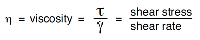
The basic unit of measurement for viscosity is poise. A material requiring a shear stress of one dyne per square centimeter to produce a reciprocal one second shear rate has a viscosity of one poise, or 100 centipoise. You will encounter viscosity measurements expressed in Pascal-seconds (Pa · s) or milli-Pascal-seconds (mPa · s); they are units of the international system and are sometimes used in preference to metric designations. One pascal-second is equal to ten poises; a milli-Pascal-second is equal to a centipoise.
This type of flow behavior that Newton assumes for all fluids is called, unsurprisingly, Newtonian. This is, however, only one of the many types of flow behavior that you may encounter. A Newtonian fluid is represented graphically in the figure below. Graph A shows that the relationship between the shear stress (F ′) and the shear rate (S) is a straight line. Graph B shows that the viscosity of the fluid remains constant as the shear rate varies. Typical Newtonian fluids include water and fluid motor oils.
Newton assumed that all materials have, at a given temperature, a viscosity independent of the shear rate. In other words, twice the force would move the fluid twice as fast. As we will see, Newton was only partly right.

In practice, this means that at a given temperature, the viscosity of a Newtonian fluid will remain constant regardless of what viscometer model, spindle, or speed you use to measure it. Brookfield viscosity standards are Newtonian in the range of shear rates generated by Brookfield equipment; this is why they can be used with all our viscometer models. Newtonians are obviously the easiest fluids to measure - just grab your viscometer and go. They are unfortunately not as common as that much more complex group of fluids, the non-Newtonians, which we will discuss in the next section.
A non-Newtonian fluid is broadly defined as a fluid for which the relation F ′ / S is not a constant. In other words, when the shear rate is varied, the shear stress does not vary in the same proportion (or even necessarily in the same direction). The viscosity of such fluids will therefore change as the shear rate varies. Thus, the experimental parameters of the viscometer model, spindle and speed all have an effect on the measured viscosity of a non-Newtonian fluid. This measured viscosity is called the apparent viscosity of the fluid and is only precise when explicit experimental parameters are provided and respected.
A non-Newtonian flow can be considered by considering any fluid as a mixture of molecules of different shapes and sizes. When they intersect, as happens during flow, their size, shape, and cohesion will determine the force needed to move them. At each specific shear rate the alignment may be different and more or less force may be required to maintain motion.
There are several types of non-Newtonian flow behavior, characterized by how the viscosity of a fluid changes in response to changes in the shear rate. The most common types of non-Newtonian fluids you may encounter include the following:
This type of fluid will show decreasing viscosity with increasing shear rate, as shown in the figure below. Probably the most common of the non-Newtonian fluids, pseudoplastics include paints, emulsions, and dispersions of many types. This type of flow behavior is sometimes referred to as shear thinning.

An increasing viscosity with an increase in the shear rate characterizes the dilating fluid; see figure below. Although rarer than pseudoplasticity, dilatancy is commonly seen in fluids containing high levels of deflocculated solids, such as clay sludge, candy compounds, corn starch in water, and sand mixtures. /water. Expansion is also referred to as shear thickening flow behavior.

This type of fluid will behave like a solid under static conditions. Some force must be applied to the fluid before a flow is induced; this force is called the elasticity value. Tomato ketchup is a good example of this type of fluid; its performance value will often cause it to refuse to pour from the bottle until the bottle is shaken or knocked, allowing the ketchup to spout freely. Once the flow limit is exceeded and flow begins, plastic fluids can exhibit Newtonian, pseudoplastic, or dilating flow characteristics. See the figure below.

So far, we have only discussed the effect of the shear rate on non-Newtonian fluids. What happens when the time element is taken into account? This question leads us to examine two other types of non-Newtonian flows: thixotropic and rheopectic.
Some fluids show a change in viscosity over time under constant shear rate conditions. There are two categories to consider:
As shown in the figure below, a thixotropic fluid undergoes a decrease in viscosity over time, while it is subjected to constant shear.
This is essentially the opposite of thixotropic behavior, in that the viscosity of the fluid increases over time as it is sheared at a constant rate. See the figure below.
Thixotropy and rheopexy can occur in combination with any of the flow behaviors discussed previously, or only at certain shear rates. The time element is extremely variable; under constant shear conditions, some fluids will reach their final viscosity value within seconds, while others can take up to several days.
Rheopectic fluids are rarely encountered. However, thixotropy is frequently observed in materials such as greases, heavy printing inks, and paints.
When subjected to varying shear rates, a thixotropic fluid will react as shown in the figure below. A plot of shear stress versus shear rate was made when the shear rate was increased to a certain value and then immediately decreased to the starting point. Note that the top and bottom curves do not coincide. This hysteresis loop is caused by the decrease in fluid viscosity with increasing shear time. Such effects may or may not be reversible; some thixotropic fluids, if left to stand for a while, will return to their original viscosity, while others never will.

The rheological behavior of a fluid can, of course, have a profound effect on the technique of measuring viscosity. Later, we'll discuss some of these effects and ways to deal with them.
The very definition of viscosity implies the existence of what is called laminar flow: the movement of one layer of fluid in front of another without transfer of material from one to the other. Viscosity is the friction between these layers.
Depending on a number of factors, there is a certain maximum speed at which one layer of fluid can move relative to another, beyond which true mass transfer occurs. This is called turbulence. Larger molecules or particles jump from layer to layer and dissipate a substantial amount of energy in the process. The net result is that more energy input is needed to maintain this turbulent flow than laminar flow at the same speed.
The increased energy input is manifested by an apparently greater shear stress than that which would be observed under laminar flow conditions at the same shear rate. This results in an erroneous high viscosity reading.
The point at which laminar flow evolves into turbulent flow depends on other factors than the speed at which the layers move. The viscosity and density of a material as well as the axis geometry of the viscometer and sample container all influence the point at which this transition occurs.
Care must be taken to distinguish between turbulent flow conditions and expansive flow behavior. In general, expander materials will exhibit a constantly increasing viscosity with increasing shear rate; turbulent flow is characterized by a relatively sudden and substantial increase in viscosity above a certain shear rate. The flow behavior of the material can be Newtonian or non-Newtonian below this point.
Due to the relatively low shear rates at which most Brookfield viscometers operate, you are unlikely to encounter turbulent flow unless you measure viscosities below 15 cP with an LV series viscometer or 85 cP with other models. The higher the viscosity of a fluid, the less likely it is to experience turbulence. If turbulence is observed when measuring low viscosity fluids, it can often be eliminated by using the UL Adapter ™ accessory.
Viscosity data often functions as a "window" through which other characteristics of a material can be observed. Viscosity is more easily measured than some of the properties that affect it, making it a valuable tool for material characterization. Earlier in this chapter, we discussed various types of rheological behavior and how to identify them. After identifying a particular rheological behavior in a material, you may wonder what this information implies about its other characteristics. This section, based on information gleaned from years of customer experience, is designed as a “tickler” to get you thinking about the mysteries your viscometer can help you solve.
One of the most obvious factors that can affect the rheological behavior of a material is temperature. Some materials are quite sensitive to temperature, and a relatively small change will cause a significant change in viscosity. Others are relatively insensitive. Consideration of the effect of temperature on viscosity is essential in evaluating materials that will be subject to temperature variations during use or processing, such as engine oils, greases and adhesives. hot melt.
Non-Newtonian fluids tend to be the rule rather than the exception in the real world, making an appreciation of the effects of shear rate a necessity for anyone engaged in the practical application of rheological data. It would, for example, be disastrous to try to pump an expanding fluid through a system, so that it solidifies inside the pump, which would abruptly stop the whole process. Although this is an extreme example, the importance of the effects of the shear rate should not be underestimated.
When a material is to be subjected to various shear rates during processing or use, it is essential to know its viscosity at the projected shear rates. If these are not known, an estimate must be made. Viscosity measurements should then be made at shear rates as close as possible to the estimated values.
It is often impossible to approximate the projected shear rate values during measurement due to these values falling outside the shear rate range of the viscometer. In this case, it is necessary to perform measurements at several shear rates and to extrapolate the data to the projected values. It is not the most accurate method of acquiring this information, but it is often the only alternative available, especially when the projected shear rates are very high. Indeed, it is always advisable to carry out viscosity measurements at several shear rates to detect rheological behavior which may have an effect on the treatment or the use. When the shear rate values are unknown or not important, a sample of the viscosity versus rpm per minute will often suffice.
Examples of materials subjected to and affected by large variations in shear rate during processing and use are: paints, cosmetics, liquid latex, coatings, certain food products, and blood in the human circulatory system. The following table shows typical examples of varying shear rates.
Labomat Essor guides you here in the choice of lamps for your UV aging enclosures QUV models or Xenon models Q-Sun
Case study: Rheological properties of powders used for the production of pharmaceutical tablets
Case Study: Photostability Testing of Cosmetics or Pharmaceuticals
Case study: Automotive paint viscosity according to ASTM D4287 or ISO 2884
Case study: Rheological properties of powder preparations for sauces
Should I Be Concerned with Color Change or with Polymer Degradation ?
PosiTector DPM : Remote Monitoring of Environmental Conditions
What is viscosity?


