



 AMETEK BROOKFIELD
 ASCOTT ANALYTICAL EQUIPMENT LTD
 ATP ENGINEERING BV
 BINDER GmbH
 BUCKLEYS (UVRAL) LTD
 COATMASTER
 DAKOTA ULTRASONICS
 DEFELSKO CORPORATION
 FORMAT MESSTECHNIK GmbH
 HACH LANGE
 HANGON
 HANNA INSTRUMENTS FRANCE
 HILDEBRAND
 KERN & SOHN GmbH
 LABOMAT ESSOR
 LAUDA
LAUDA
 LENETA COMPANY
 MITUTOYO FRANCE
 Q-LAB CORPORATION
 RHOPOINT INSTRUMENTS
 RK PRINT COAT INSTRUMENTS Ltd
 SIGMUND LINDNER GmbH
 TABER INDUSTRIES
 TAYLOR HOBSON LIMITED
 TESTO
TESTO
 TQC BV
 VEOLIA WATER STI
 VERIVIDE
 WALLACE
 X-RITE EUROPE GMBH


To relieve cough and chest congestion.
Instrument: Viscometer or rheometer
Torque range: RV
Pin: YULA-15E
Accessories: Enhanced UL Adapter,
TC-550AP
Programmable wash speed: 50, 60, 70, 80, 90, 100, 110, 120, 130, 140, 150, 160 and 170 rpm
Temperature: 22 ° C
We used a Brookfield RVDV3T rheometer with Rheocalc ™ software for automated instrument control and data acquisition. The temperature was controlled using a ULA-EY water jacket connected to a TC-550AP refrigerated programmable bath. We conducted three trials to determine repeatability. A syringe was used to measure and dispense 16 ml of the substance into the sample chamber. The spindle and chamber were cleaned before each test, and fresh material was used in each test. We equilibrated the sample, spindle, and chamber for at least three minutes prior to testing. We performed our test in speed ramp mode. Using traditional RV speeds such as 50 and 100 RPM may be a sufficient test for this type of material. However, since we were using a DV3T rheometer, we had the flexibility to run the test at a wide variety of speeds.
Figure 1 shows that Mark A and Mark B are essentially Newtonian fluids. Newtonian fluids are characterized by a constant viscosity, independent of the shear rate. Slight differences in viscosity over our shear rate range can be explained by the tolerance of 1% of the instrument. Figure 1 also shows that brand A is more viscous than brand B.
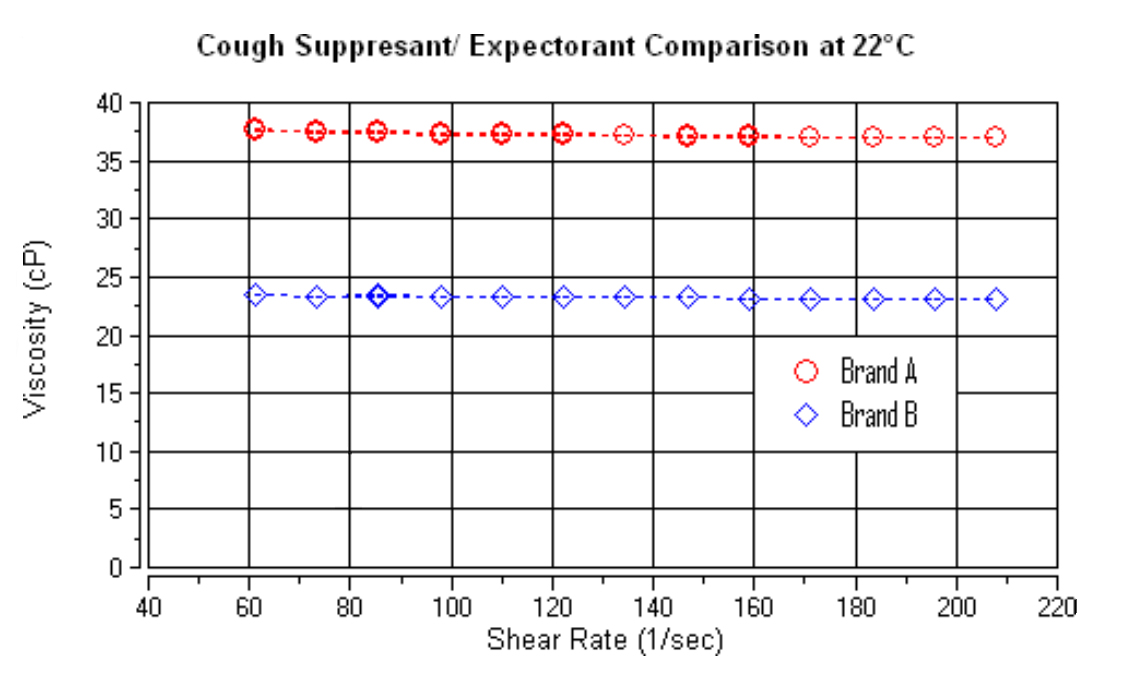
Figure 1: Viscosity versus shear rate
Instrument: DV3T / DVnext rheometer
Torque range:
LV pin: YULA-15E
Accessories: Enhanced UL Adapter, TC-550AP Programmable Bath
Speed: 3, 4, 5, 6, 7, 8, 9, 10, 11, 12, 13, 14 and 15 rpm
Temperature: 22 ° C
We used a Brookfield LVDV3T rheometer with Rheocalc ™ software for automated instrument control and data acquisition. The temperature was regulated using a ULA-EY water jacket connected to a TC-550AP programmable bath. We conducted three trials to determine repeatability. A syringe was used to measure and dispense 16 ml of the substance into the sample chamber. The spindle and chamber were cleaned before each test, and fresh material was used in each test. We equilibrated the sample, spindle, and chamber for at least three minutes prior to testing. We performed our test in speed ramp mode. Using traditional LV speeds such as 3, 6 and 12 RPM may be a sufficient test for this type of material. However, since we were using a DV3T rheometer, we had the flexibility to run the test at a wide variety of speeds.
Figure 2 shows that Mark A and Mark B are essentially Newtonian fluids. Newtonian fluids are characterized by a constant viscosity, independent of the shear rate. Slight differences in viscosity over our shear rate range can be explained by the tolerance of 1% of the instrument. Figure 2 also shows that brand A is more viscous than brand B.
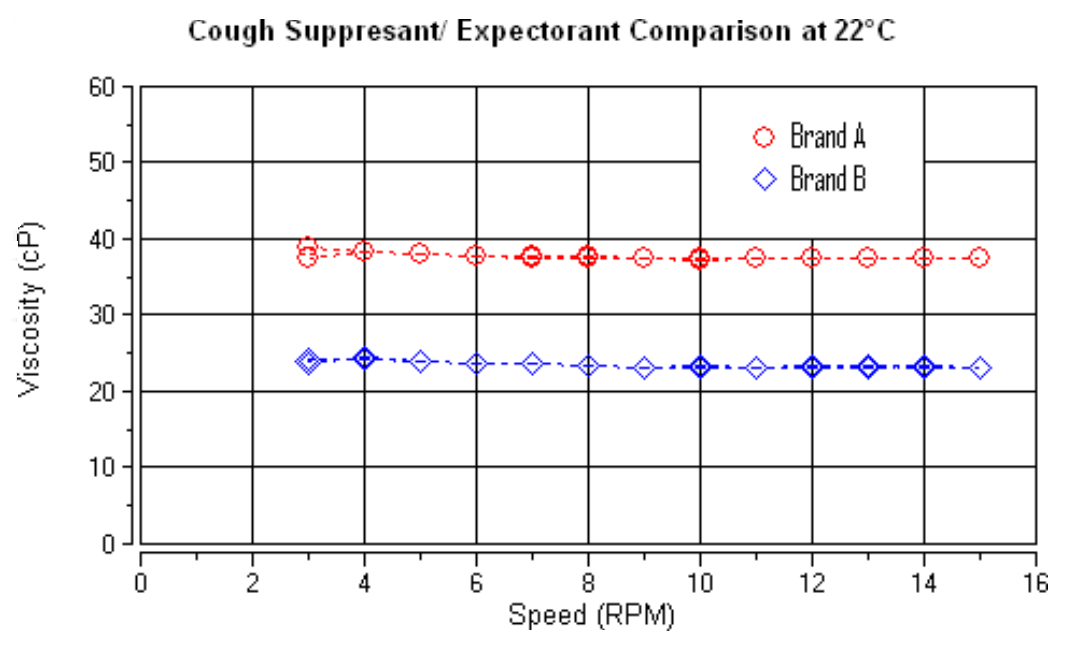
Figure 2: viscosity vs rotational speed
How to better use your viscometer or rheometer using accessories
What types of weathering and corrosion standards are there, and what’s in them ?
Reference: PosiTector
The PosiTector box is a multifunction measuring device which is the ideal tool to support you in your various measurements. Compatible with many types of probes it will adapt to your needs. Connected, it is compatible with many software solutions on computer, tablet, smartphone, in the cloud or linked to third-party applications.
Labomat, expert in light and weathering tests, presents a series of webinars dedicated to light and weathering tests (Weathering)
How to clean spiral bars (Bar coaters, Meyer bars)?


