


Dimensions of Brookfield mobiles (Part 2)
Descriptions, ranges and measurement parameters of Brookfield viscometers and accessories

 AMETEK BROOKFIELD
 ASCOTT ANALYTICAL EQUIPMENT LTD
 ATP ENGINEERING BV
 BINDER GmbH
 BUCKLEYS (UVRAL) LTD
 COATMASTER
 DAKOTA ULTRASONICS
 DEFELSKO CORPORATION
 FORMAT MESSTECHNIK GmbH
 HACH LANGE
 HANGON
 HANNA INSTRUMENTS FRANCE
 HILDEBRAND
 KERN & SOHN GmbH
 LABOMAT ESSOR
 LAUDA
LAUDA
 LENETA COMPANY
 MITUTOYO FRANCE
 Q-LAB CORPORATION
 RHOPOINT INSTRUMENTS
 RK PRINT COAT INSTRUMENTS Ltd
 SIGMUND LINDNER GmbH
 TABER INDUSTRIES
 TAYLOR HOBSON LIMITED
 TESTO
TESTO
 TQC BV
 VEOLIA WATER STI
 VERIVIDE
 WALLACE
 X-RITE EUROPE GMBH

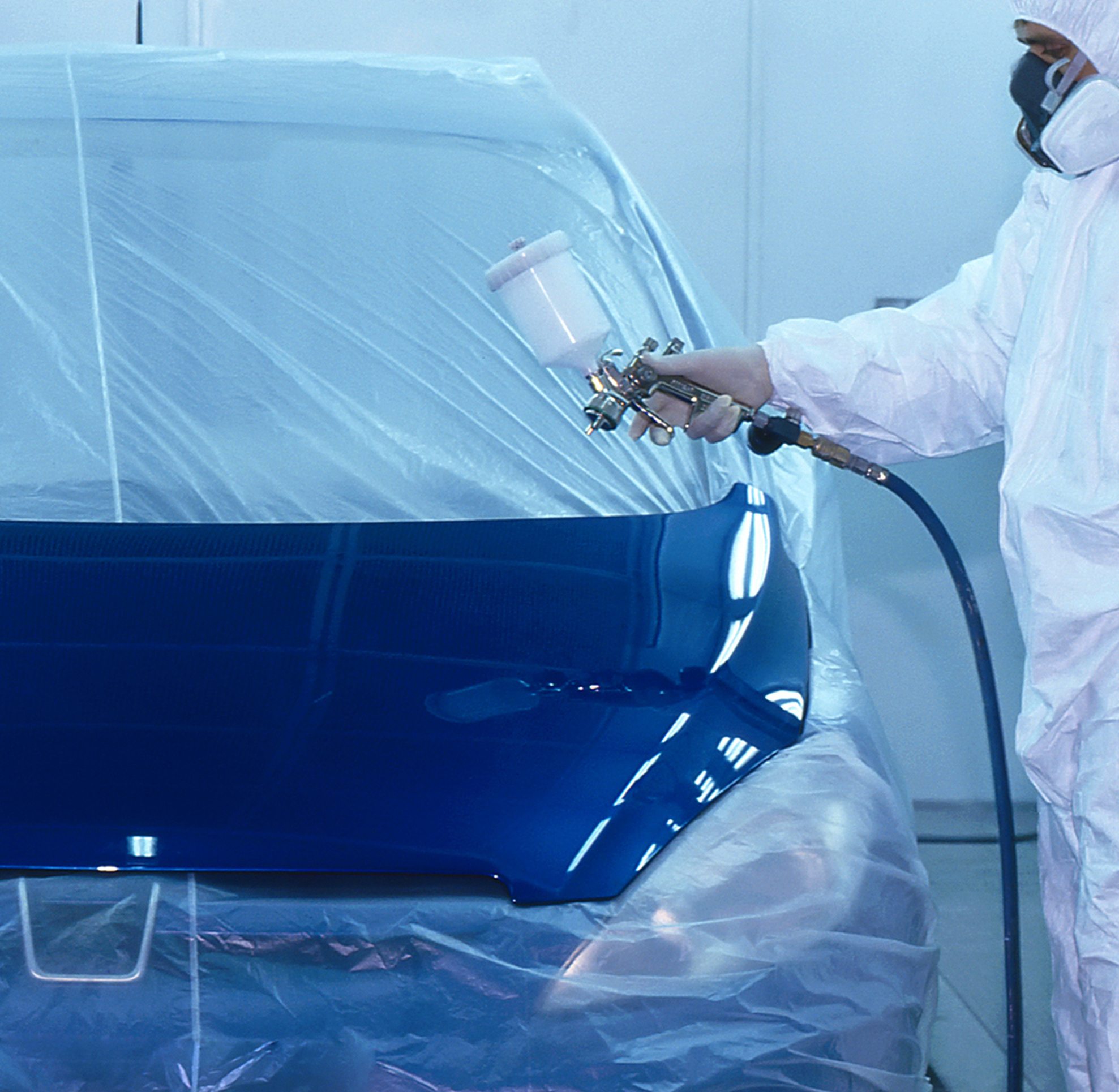
Painting automobile exteriors, making their appearance more attractive.
Viscometer: CAP 2000 + L high torque
Brooch: Cone 01 (CAP-S-01)
Speed: 750 and 900 rpm
Temperature: 25 ° C
The paint is tested at high shear rates (10,000 -12,000 s-1), to simulate the flow behavior that paints undergo during spraying. The test methods we used were based on the standard test methods defined by ASTM D4287 (common standard in North America) which is performed at 12,000 s-1, and the standard test methods defined by ISO2884 and BS3900 (common standards in Europe), which run at 10,000 s-1.
We used a CAP 2000 + L high torque viscometer, with Capcalc software for automated instrument control and data acquisition. We used Cone 01 to get scale results with 67 L of fluid sample. The cone and plate were cleaned before dispensing each portion of paint. A new portion of sample was used for each test. Three tests were carried out for each speed. We equilibrated the sample and cone at 25 ° C for 30 seconds before testing. The solvent trap was used to help prevent evaporation. Representative data from the analyzes are presented in Figures 1, 2 and 3. The
Figure 1 shows the data obtained by the standard test method described by ISO 2884 most commonly used in Europe.
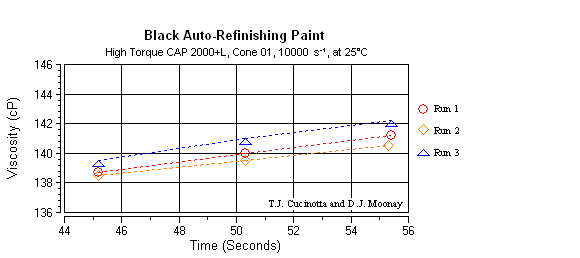
Figure 1: ISO 2884 standard test method
Figure 2 shows the data obtained by the standard test method described by ASTM D4287 more commonly used in North America.

Figure 2: Standard test method D4287
Figure 3 plots execution 1 of figures 1 and 2.

Figure 3: Comparison of test methods: ISO 2884 versus ASTM D4287 La
Figure 3 shows that the viscosity obtained in ISO 2884 is slightly higher than that of ASTM D4287. The slight increase in viscosity over time can be attributed to solvent evaporation from the paint sample.
Descriptions, ranges and measurement parameters of Brookfield viscometers and accessories
Reference: Dureté Shore / DIDC / Micro DIDC
What are the differences between Shore, DIDC, Micro DIDC hardness scales?
Case study: Rheological properties of ground cinnamon
Measuring Paint Thickness on Plastic Bumpers/Fascias with Advanced Driver Assistance Systems (ADAS)
Case study: Measurement of consistency of tofu or curd
Probe selection guide for PosiTector 6000 thickness gauge
PosiTector DPM : Remote Monitoring of Environmental Conditions
Verification, by the high voltage method, of the continuity of a coating applied to a cement-based substrate.
How many Langleys or Joules or Watts / m2 do the Q-SUN and QUV testers produce?
How often should I have my measuring device calibrated?
Case study: Measuring the hardness and crispness of banana crisps


