Salt fog: what connections to plan?
You are about to invest in a salt spray enclosure and you are wondering about the connections to be made, you will find some useful information below:
Energy connections:
- Electrical connections:
220 V single-phase or 380 V three-phase depending on the enclosure model
- Continuous demineralized water connection
(for automatic filling of the humidification tower) and for the preparation of the saline solution)
The ISO 9227 standard requires water with a conductivity less than 20 µS measured at 25 ° C + - 2 ° C
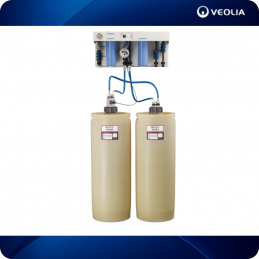
Labomat Essor offers demineralization systems adapted to your needs.
- Compressed air connection:
The compressed air used to supply the enclosure must be clean, dry and oil-free.
Connections to the drains:
- Evacuation of corrosive vapors :
The salt spray enclosures constantly create fog. The enclosures must therefore be connected to the exterior of the building to balance the pressure between the interior of the enclosure and the exterior of the building. The connection is made using rigid PVC pipes to the outside of the building. It is not necessary and it is not recommended to provide for an extraction (indeed, this would have the effect of emptying the fog created in the enclosure). This connection also makes it possible to purge the enclosure before opening the cover. We recommend that you take care not to create a siphon which, when filling with liquid, might prevent the evacuation of the mist.
- Condensate evacuation:
Some of the vapors condense inside the enclosure and therefore create a volume of saline solution which is discharged through the bottom of the enclosure using a drain connected to the sewer or to a buffer tank .
Other elements to plan:
- Saline solution tank
(if it is not offered with your speaker) of sufficient volume to be able to operate continuously for 1 week
- Standardized salt:
Different salt spray standards dictate the use of high quality salt.
According to ISO 9227, the salt must not contain a total mass fraction of heavy metals Copper (Cu), Nickel (Ni) and Lead (Pb) greater than 0.005 %. It must not contain a mass fraction of sodium iodide greater than 0.1% nor a fraction of total impurities greater than 0.5% percentages calculated on the basis of dry salt.
Note: Sodium chloride with anti-caking agent added can act as a corrosion inhibitor or accelerator, it is recommended to use pharmaceutical grade sodium chloride salt.
- Test tube holder:
When the tests are carried out on test panels, according to ISO 9227, an angle of 20 ° + - 5 ° with respect to the vertical must be respected. Labomat Essor offers specimen holders meeting these specifications. Custom specimen holders also available.
- Condensate volume measurement kit :
These are graduated cylinders surmounted by funnels of 80 cm² (100 mm in diameter) allowing to determine the quantity of condensate produced daily.
- pH meter, conductivity meter :
Used to measure the quality of demineralized water (conductivity) used for the preparation of the saline solution as well as to measure the pH of the condensates.
- Aerometer, refractometer, hydrometer or salinimeter:
Used to measure the concentration of saline solution
- Corrosion coupons:
These are reference test panels used to determine the corrosivity of an enclosure.
The ISO 9227: 2017 standard (Corrosion tests in artificial atmospheres - Salt spray tests) recommends the use of corrosion coupons made of CR4 steel and describes the method for carrying out the corrosivity test.
For detailed information, we invite you to contact Labomat Essor