AMETEK BROOKFIELD
 ASCOTT ANALYTICAL EQUIPMENT LTD
 ATP ENGINEERING BV
 BINDER GmbH
 BUCKLEYS (UVRAL) LTD
 COATMASTER
 DAKOTA ULTRASONICS
 DEFELSKO CORPORATION
 FORMAT MESSTECHNIK GmbH
 HACH LANGE
 HANGON
 HANNA INSTRUMENTS FRANCE
 HILDEBRAND
 KERN & SOHN GmbH
 LABOMAT ESSOR
 LAUDA
LAUDA
 LENETA COMPANY
 MITUTOYO FRANCE
 Q-LAB CORPORATION
 RHOPOINT INSTRUMENTS
 RK PRINT COAT INSTRUMENTS Ltd
 SIGMUND LINDNER GmbH
 TABER INDUSTRIES
 TAYLOR HOBSON LIMITED
 TESTO
TESTO
 TQC BV
 VEOLIA WATER STI
 VERIVIDE
 WALLACE
 X-RITE EUROPE GMBH

Why do Q-Lab testers require specific calibration radiometers?
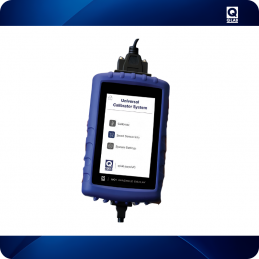
QUV and Q-SUN accelerated weathering testers require the use of special calibration radiometers. The CR10 and UC10 are used for fluorescent UV lamps and the CR20 and UC20 are used for xenon lamps. These NIST-traceable devices ensure that the irradiance delivered to test specimens equals the irradiance called for in the user’s test method. Q-Lab’s lamps must be calibrated specifically with this radiometry equipment because of spectral mismatch between different UV fluorescent lamps or optical filters. Spectral mismatch is the effective difference in reading observed from an irradiance sensor when using a different spectrum than was used for calibration.
Q-Lab’s on-board and calibration irradiance sensors work using a photodiode, a semiconductor that converts absorbed photons into an electrical current. Since the photodiodes used in irradiance sensors only measure the intensity of light, but not the wavelength of light, filtering is used to make narrowband (310 nm, 340 nm, 420 nm), or wideband (TUV, 300-400 nm) irradiance measurements. If an on-board sensor is calibrated with a particular light spectrum, some error will be introduced when trying to measure irradiance using a different light spectrum.
For example, in a QUV, if you were to try and measure the irradiance of a UVB-313 lamp using a radiometer calibrated for use with a UVA-340 lamp, you would get an erroneous reading. A similar error would occur in a Q-SUN if trying to measure the irradiance at 340 nm with a Daylight-F filter using a radiometer calibrated for Window-Q. This is why it’s important to use the correct setting and device when calibrating a QUV or Q-SUN accelerated weathering tester.
Do Q-Lab's Fluorescent UV and Xenon Lamps Meet International Standards for Irradiance?
Can the Q-SUN Run “Solar Radiation” Tests Found in Environmental Testing Standards ?
How many Langleys or Joules or Watts / m2 do the Q-SUN and QUV testers produce?
Case Study: Acid Rain Simulation for Automotive Coatings
How to predict the demineralization capacity of the resins of a demineralizer?
Case Study: Photostability of Household Detergent Cleaner
Should I Be Concerned with Color Change or with Polymer Degradation ?
Case Study: Photostability Testing of Cosmetics or Pharmaceuticals
I've never done weathering testing, but I'm interested. What's next ?
Why do Q-Lab testers require specific calibration radiometers?