


 AMETEK BROOKFIELD
 ASCOTT ANALYTICAL EQUIPMENT LTD
 ATP ENGINEERING BV
 BINDER GmbH
 BUCKLEYS (UVRAL) LTD
 COATMASTER
 DAKOTA ULTRASONICS
 DEFELSKO CORPORATION
 FORMAT MESSTECHNIK GmbH
 HACH LANGE
 HANGON
 HANNA INSTRUMENTS FRANCE
 HILDEBRAND
 KERN & SOHN GmbH
 LABOMAT ESSOR
 LAUDA
LAUDA
 LENETA COMPANY
 MITUTOYO FRANCE
 Q-LAB CORPORATION
 RHOPOINT INSTRUMENTS
 RK PRINT COAT INSTRUMENTS Ltd
 SIGMUND LINDNER GmbH
 TABER INDUSTRIES
 TAYLOR HOBSON LIMITED
 TESTO
TESTO
 TQC BV
 VEOLIA WATER STI
 VERIVIDE
 WALLACE
 X-RITE EUROPE GMBH
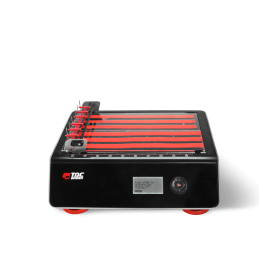
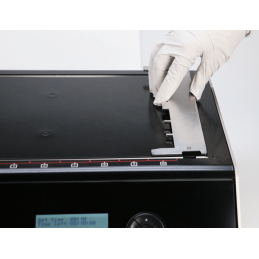
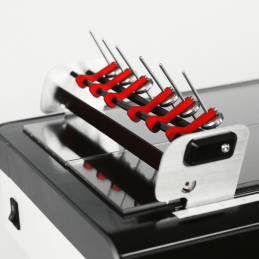

AB3600 drying time logger
The AB3600 recorder is a device for measuring the drying time of paints, varnishes and adhesives using needles moving at constant speed on glass plates on which the products to be tested have been deposited.
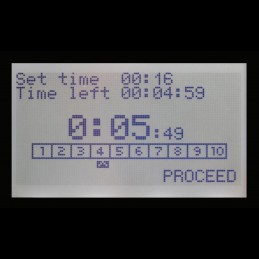
Thanks to its digital interface, the speed of movement can be easily modified according to your needs to evaluate drying times ranging from 1 minute to 200 h.
Complies with the BK method (Beck Koller) and standards: ASTM D5895, ISO 9117-4 and DIN EN 14022 standards
The TQC Model AB3600 Drying Time Recorder is a fully digitally controlled machine for defining the various stages of the drying process for paints and coatings.
The drying time recorder operates according to the BK (Beck Koller) method. Defining the end result or verifying intermediate steps is very easy thanks to the clear digital display and intuitive interface. It also complies with ASTM D5895, ISO 9117-4 and DIN EN 14022 standards.
The drying time recorder has six tracks and comes with two sturdy, reusable 100 X 350 X 3mm glass plates. Optionally six narrow glass plates in special adapters.
The front panel of the drying time recorder is made of transparent glass, which is easy to clean and protects the screen below. The drying time recorder is powered by a 24 V DC power supply.
The ability to perform tests at temperatures as low as -20 ° C is unique. The drive system is lubricant-free, so there is no risk of the lubricants thickening at lower temperatures. The screen is heated, which improves menu visibility at lower temperatures. These design features result in a wide operating temperature range of -20 ° C to + 70 ° C (non-condensing), allowing testing in climatic chambers.
A wide and adjustable time range can be set, varying from 1 minute to 200 hours. This makes the Dry Time Recorder suitable for fast drying water based coatings as well as very slow drying paints which may take several days to dry. The time settings are very precise,
- Paints and varnishes (aqueous or solvent-based)
- Nail polish
- Adhesives
ASTM D5895 - 03 and ISO 9117-4: 2012 standards identify different stages of drying time.

The stylus creates a pear-shaped mark at the top of the film. The paint no longer flows on the path created by the stylus and lets the glass substrate appear.
Evaporation of the solvent or water results in a solidified film which no longer sticks to the finger when touched.
The continuous trace in the film ceases and the stylus begins to tear the film or leave a sharp or scruffy mark.
Note: Coatings such as polyurethanes or two-component epoxies can form a different pattern here in the shape of a butterfly or a kite.
Non-sticky state is achieved, light objects placed on the paint film will not stick.
The stylus moves across the surface of the paint film and leaves no visual mark on the surface.
Paint film is not moved or scored by gently pinching a coated panel between index finger and thumb
The stylus is taken out of the film and goes up on top. It leaves a small mark without damaging the body of the film.
The paint film is not moved or scored by pinching a coated panel between the index finger and thumb with medium force.
Cups in anodized aluminum for measuring the permeability of paints, varnishes, plastics, etc., to water vapor.
An optional drying time recording tool is available to convert the Model AB4120, AB4220 and AB4320 Automatic Film Applicators to drying time recorders.
Determine the minimum film formation temperature using a nickel-plated brass plate producing a gradual temperature gradient. Particularly recommended for emulsion paints, this device also allows the study of the drying constraints of aqueous coatings and non-pigmented latexes.
Manual system allowing to cut samples of fabric, carpet, film or paper by carrying out a simple rotation of 90 ° with the cutting tool with which it is provided.
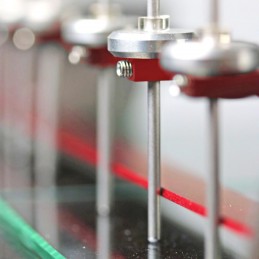
Each of the needles of the needle holder moves at a constant adjustable speed on a glass plate on which the product to be tested has been applied beforehand. A time scale fixed on the casing makes it possible to determine the times corresponding to each stage of the drying process: solvent evaporation time, dust free, tack free, through dry.
Apparatus for characterizing the baking, drying and acid attack behavior of paints, powders, resins, silicones and similar materials by simulating the production process.
AB3600 drying time logger
The AB3600 recorder is a device for measuring the drying time of paints, varnishes and adhesives using needles moving at constant speed on glass plates on which the products to be tested have been deposited.
Thanks to its digital interface, the speed of movement can be easily modified according to your needs to evaluate drying times ranging from 1 minute to 200 h.
Complies with the BK method (Beck Koller) and standards: ASTM D5895, ISO 9117-4 and DIN EN 14022 standards


